Items and warehouses
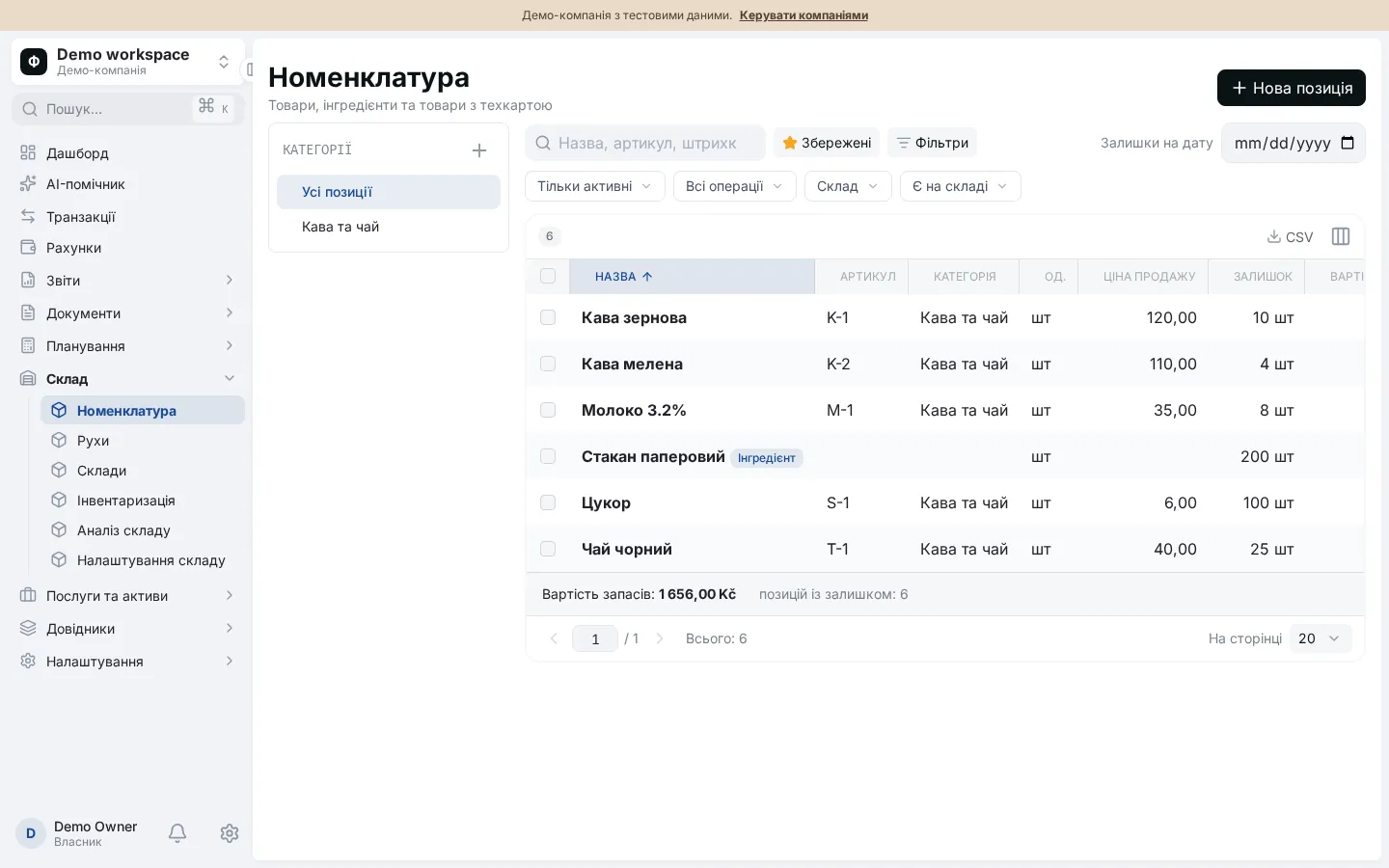
Group tree, units of measure, opening balances, archive and restore, bulk edit, CSV export. Several warehouses, each with its own balances.
Manage items, warehouse balances, cost, services with recipes and depreciating fixed assets, and see them on your balance sheet.
The inventory, services and fixed assets module in Financist keeps items, warehouses, stock movements and stock counts, calculates cost using FIFO or moving average, analyses stock and maintains a service registry with recipes. Fixed assets get a depreciation schedule, and the value of stock and assets flows into the balance sheet.
An item (nomenclature) is the list of goods, materials and services your business works with. A warehouse is a storage location with balances. A movement is a document that changes stock: purchase, sale, write-off, transfer, adjustment. A fixed asset is long-lived property whose cost is written off through depreciation.
This module lets you see in one place not only the cash in your accounts but also what you bought with it: how much stock you hold, what it cost, what is not selling and which equipment is already worn down. The value of stock and the net book value of assets feed the balance sheet, and the cost of goods sold affects the profit and loss statement.
The method is chosen in warehouse settings: FIFO (by batch) or moving average. Cost is calculated separately for each warehouse. Shortages are allowed: negative stock is valued at the last known cost and a later receipt books the variance. Prices are entered including VAT, and stock is booked net of VAT.
Group tree, units of measure, opening balances, archive and restore, bulk edit, CSV export. Several warehouses, each with its own balances.
Purchase, sale, write-off, additional expenses, adjustment, transfer between warehouses. A movement can be linked to a transaction; rows can be imported from JSON or CSV or pasted.
Enter actual balances and the system shows the differences before anything is applied. On confirmation an adjustment is created.
Turnover and stock value, ABC split, slow and stale items by days without sales, days of cover. Thresholds are configurable.
A service catalogue with components and a cost breakdown. In the sales and receipts registry each service sold consumes its components from stock.
Asset categories, commissioning date, straight-line or declining-balance depreciation, a posting schedule, disposal and reversal of disposal.
Each movement changes balances and recalculates cost, and the order of same-day operations is defined.
| Movement type | What happens | Effect on cost |
|---|---|---|
| Purchase | Goods received into stock | Creates a batch at the net-of-VAT price |
| Sale | Goods shipped from stock | Writes off cost by FIFO or average |
| Write-off | Losses and scrap removed | Writes off cost |
| Additional expenses | Delivery, customs fees | Spread pro rata over remaining stock |
| Transfer | From one warehouse to another | The batch keeps its cost |
| Adjustment | Result of a stock count | Aligns book and actual balances |
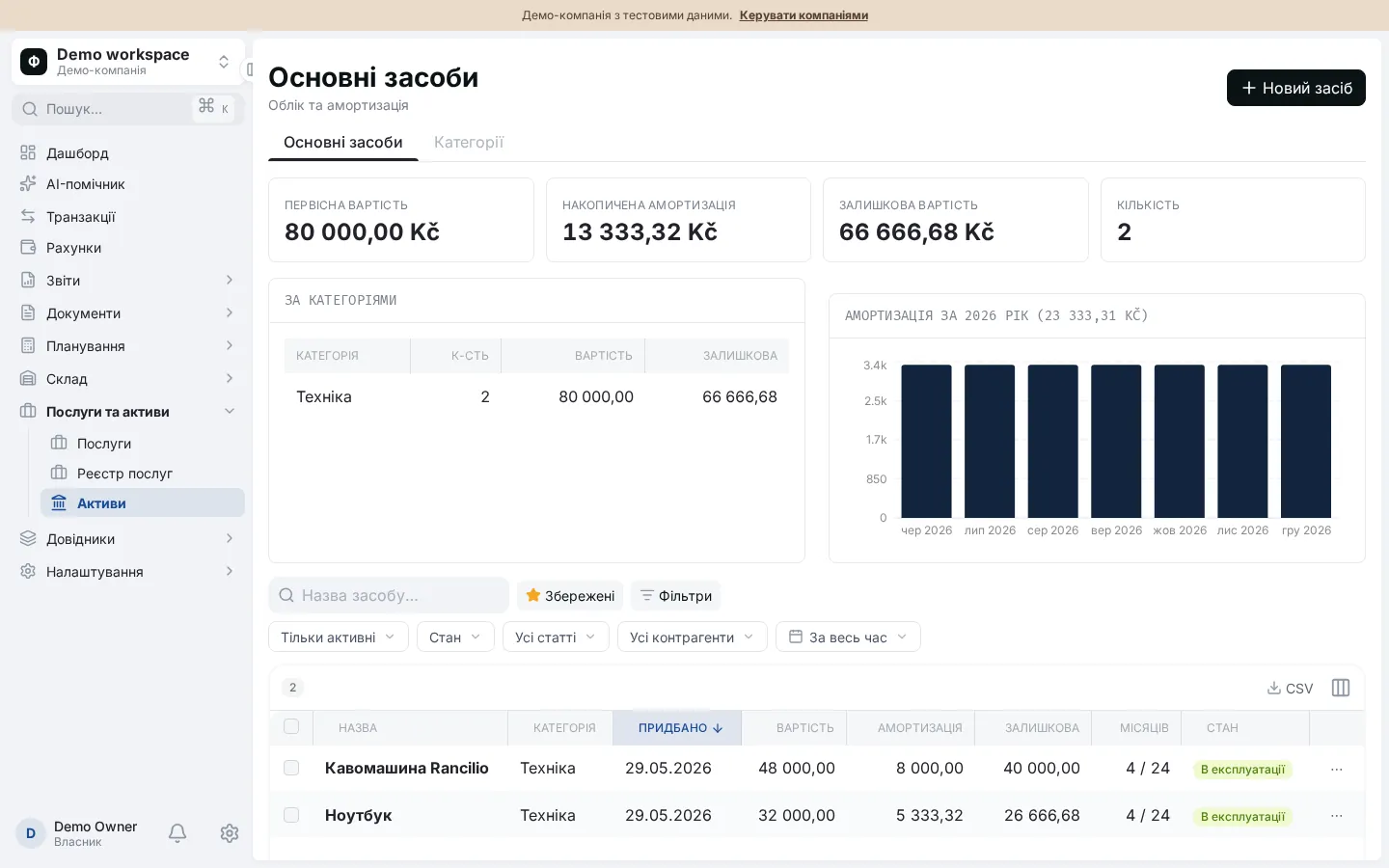
Depreciation is posted monthly: the first charge is the month after commissioning, and the last month absorbs rounding. There are no production documents yet (output of finished goods from components): a recipe consumes components on sale or write-off. Posting a document in documents and approvals does not create stock movements by itself; they are entered in the movements section.
You choose between FIFO (by batch) and moving average in warehouse settings. Changing the method asks for confirmation because it recalculates cost. Calculation runs separately for each warehouse. Shortages are allowed and valued at the last known cost, and a later receipt books the difference.
You enter actual balances and the system compares them with book balances and shows the differences without saving anything. After you confirm, an adjustment movement is created that aligns the balances. The count page is available to users who may manage items.
Yes. Services have their own catalogue and a registry of sales and receipts. A service can have a recipe with components; when it is sold the system consumes them from stock and shows the cost breakdown. A service without components simply works as a line without stock.
Straight-line and declining balance, floored at the salvage value. Charges start the month after commissioning and are posted at month end. Parameters come from the asset category or can be set on the asset itself. Disposal stops the charges and can be reversed.
Yes. Stock value at a date and the net book value of fixed assets are used when the balance sheet is built, so one report shows not only cash but also the value of goods in stock and the remaining value of equipment.