Balance on a date
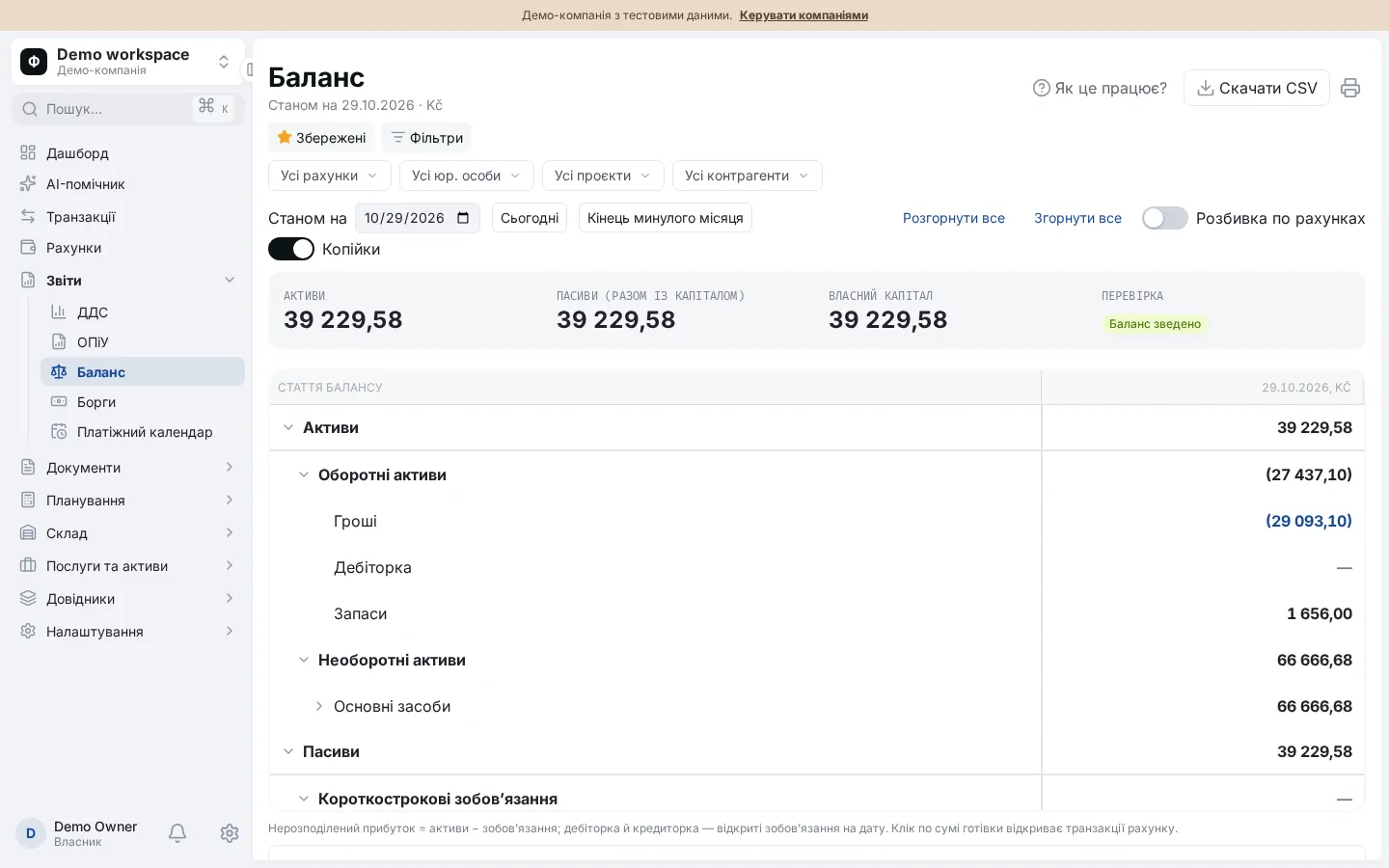
Pick a date or press "Today" or "End of last month". Assets, liabilities, equity and a reconciliation check are shown on top.
A snapshot of what the business owns and owes on any date, plus a separate report of who owes whom and for how long.
The balance sheet in Financist shows, for a chosen date, what the business owns (cash, receivables, stock, fixed assets) and what it owes (payables); the difference is equity. A separate debt report breaks receivables and payables down by counterparty and by ageing, down to the individual document.
A balance sheet is a snapshot of financial position on a specific date: what the business has (assets), what it owes (liabilities) and what is left for the owner (equity). Unlike the cash flow statement and the P&L, it is about a moment, not a period. The three reports are compared in the guide to cash flow, profit and balance.
This is a management balance sheet, built automatically from your accounts, transactions and commitments. It is not official statutory accounting.
You can pick any date up to today.
Pick a date or press "Today" or "End of last month". Assets, liabilities, equity and a reconciliation check are shown on top.
One switch expands cash into individual accounts and lets you jump to their transactions.
Receivables ("owed to us") and payables ("we owe") by counterparty, together with cash on accounts and the net position.
Columns: not yet due, 0–30, 31–60, 61–90 and over 90 days overdue.
Expand a counterparty to see date, description, amount, paid, remaining and days overdue for each commitment.
Accounts, legal entities, counterparties and projects; CSV export and print.
| Section | What it includes | Where the data comes from |
|---|---|---|
| Cash | Account balances converted at the rate | Accounts and transactions |
| Receivables | Unpaid commitments owed to us | Transactions marked as commitments |
| Stock | Warehouse balances | Warehouse records (inventory and assets) |
| Fixed assets | Cost minus accumulated depreciation | Asset records (inventory and assets) |
| Payables | Unpaid commitments to counterparties | Transactions marked as commitments |
| Equity | Assets minus liabilities | Calculated automatically |
The balance sheet and debts matter to owners, finance managers and accountants when the question is solvency rather than a single month. The reports answer:
For example, cash is 5,000 EUR, receivables 3,000 EUR, stock 2,000 EUR and fixed assets 10,000 EUR: assets total 20,000 EUR. Payables are 4,000 EUR, so equity is 16,000 EUR. If a customer was due to pay 1,000 EUR and the date passed 45 days ago, that amount sits in the "31–60 days" column. To see whether cash will cover upcoming payments, open the payment calendar.
A balance sheet is a snapshot of the business on a date: what it has (cash, customer debts, stock, equipment), what it owes and what is left for the owner. Assets always equal liabilities plus equity. Unlike the cash flow statement and the P&L, it does not show turnover for a period.
From transactions marked as commitments. While a commitment is unpaid it counts as a debt, and payments linked to it reduce the remaining amount. If a customer is due to pay you, it is a receivable; if you are due to pay, it is a payable.
No. It is a management balance sheet for decision-making, built from the data in Financist. Official statutory accounts are prepared by an accountant according to the law of your country.
For any date up to today. There are quick buttons for "Today" and "End of last month". Cash is calculated from account balances on that date.
The age is counted from the commitment date. If the date has not arrived yet, the debt is in "Not yet due"; after that it moves to 0–30, 31–60, 61–90 or over 90 days overdue. You can see at once what to chase first.